
TYT MD-9600
Supported
One image serves every board revision. On a V1-V3 radio, FM and DMR on both bands, DMR voice and data, text messages, roaming, scan, dual watch, APRS, the hotspot, each split duplex half and the USB network services work on air, with every power level checked on a wattmeter on both bands. Transmit is armed per power cycle. Open: V4 and V4A/V5 boards have not run on a radio, and SFR loses inbound voice frames.
- Also sold as
- Retevis RT90
- Type
- Mobile
- Bands
- 136-174 / 400-480 MHz
- Power
- up to 50 W
- Processor
- STM32F405
- Screen
- monochrome, 128 × 64
- Voltage reading
- Supply (DC input)
- Clock kept when off
- Not known yet
Screens
Features
| Feature | Full | Amateur | Commercial |
|---|---|---|---|
| Radio and voice | |||
Analog FM receive and transmitFM | included | included | included |
CTCSS / DCS encode and decodeSUBTONE | included | included | included |
DMR Tier II voice (modem, call stack, AMBE FEC, vocoder)DMR | included | included | included |
Basic privacy (Motorola / Anytone BP)DMR_PRIVACY | included | left out | included |
Talker alias receive and sendDMR_TALKER_ALIAS | included | included | included |
ETSI GPS Info in the embedded LCDMR_GPS | included | included | included |
CSBK signaling: call alert, radio checkDMR_SIGNALING | included | included | included |
DMR emergency (alarm, emergency call, hot mic)DMR_EMERGENCY | included | included | included |
Repeater roamingDMR_ROAMING | included | included | included |
VFO (hand-tuned frequency)VFO | included | included | included |
FM VFOVFO_FM | included | included | included |
DMR VFO (color code, slot, talk target typed in; mode change FM / DMR)VFO_DMR | included | included | included |
Scan, band scan, dual watch, nuisance deleteSCAN | included | included | included |
Dual watch: A and B in any zone or the VFO, PTT on the selected one, its screens, talk backDUAL_WATCH | included | included | included |
Beeps and alert tonesBEEP | included | included | included |
FM TX tones: roger beep, 1750 Hz burstFM_TX_TONES | included | included | included |
DTMF transmit from the keysDTMF | included | included | included |
FM VOXVOX | included | included | included |
Frequency trim, Settings > AdvancedREF_TRIM | included | included | included |
Receiver battery saverBATTERY_SAVE | included | included | included |
GPS receiver: the module driver and its NMEA input (Settings > Location > GPS)GPS | included | included | included |
Key assignment (Settings > Keys, codeplug)KEY_ASSIGN | included | included | included |
Channels list: every channel by number, a channel's settings (hub 5)CHANNEL_LIST | included | included | included |
Channel editor: edit a channel, New channel from current settings, text entryCHANNEL_EDIT | included | included | included |
Zone editor: move, add, copy and remove channels in a zone; rename, copy and delete a zoneZONE_EDIT | included | included | included |
Contact editor: a new contact from Find or a call's actions (name, ID, type, timeslot)CONTACT_EDIT | included | included | included |
Volume bar when a knob the MCU reads turns (#354)VOLUME_BAR | included | included | included |
| DMR data | |||
Text messages (ETSI IP text by default)DMR_SMS | included | included | included |
Motorola TMS text formatDMR_TMS | included | left out | included |
ARS registrationDMR_ARS | included | left out | included |
LRRP locationDMR_LRRP | included | left out | included |
Zone and channel sharing: send a zone or a channel, import an offered oneZONE_SHARE | included | included | included |
Compressed UDP/IP headers on transmit (SAP 3)DMR_UDP_COMPRESS | included | included | included |
Single frequency repeater: MMDVM SFR, and the standalone SFR (experimental)SFR | included | included | included |
Experimental: SFR user receive "dual-path RX": a voice frame whose FEC failed comes from the other copySFR_DUALPATH_RX | included | included | included |
Experimental: standalone SFR repeater's periodic CW ID (callsign in Morse, FM)SFR_CWID | included | included | included |
APRS: AFSK positions, status, messages; DMR positions; KISS TNCAPRS | included | included | left out |
APRS receive: demodulator, station list, digipeaterAPRS_RX | included | included | left out |
APRS iGate rules (with tools/aprs_gate.py)APRS_IGATE | included | included | left out |
GPS screen: sky plot, signal bars, grid locator (Tools > Position)GPS_SKY | included | included | left out |
| Network (USB network adapter and IP over DMR) | |||
IP over DMR gatewayDMR_IP_GATEWAY | included | included | included |
Minimal TCPNET_TCP | included | included | included |
KISS over TCP, port 8001NET_KISS | included | included | left out |
HTTP status page and JSON, port 80NET_HTTP | included | included | included |
HTTP static files stored and served gzip compressedNET_HTTP_GZIP | included | included | included |
Web control: the front panel page, keys, status and receive audio over /wsNET_WEBCTL | included | included | included |
rigctld, port 4532NET_RIGCTL | included | included | included |
APRS-IS clientNET_APRSIS | included | included | left out |
Audio linking (USRP over UDP, port 34001)NET_USRP | included | included | included |
mDNS / DNS-SD (rfoundry-<id>.local)MDNS | included | included | included |
TFTP codeplug read / writeTFTP | included | included | included |
DMR ID database over TFTP (iddb.bin, combined codeplug.bin)TFTP_IDDB | included | included | included |
Compact DMR ID database (format C) read beside format NIDDB_COMPACT | included | included | included |
Control station mode (boot as network, PC answers data, fixed link)DMR_CONTROL_STATION | included | left out | included |
SNMP v2c agent and traps (USB and over the air)SNMP | included | left out | included |
USB network adapter (CDC-NCM)USB_NETWORK | included | included | included |
PPP on the serial host port (IPv4 into the gateway)NET_PPP | left out | left out | left out |
| Host link and USB | |||
Task stacks in the debug link viewTASK_STACKS | included | included | included |
USB deviceUSB | included | included | included |
Host link: hotspot, CPS, debug link on the host portHOSTLINK | included | included | included |
MMDVM hotspotHOTSPOT | included | included | left out |
Split duplex repeater (two radios, one duplex modem)HOTSPOT_SPLIT | included | included | left out |
Debug linkDEBUGLINK | included | included | included |
Open-firmware CPS protocol (qdmr)CPS_OPENFW | included | included | included |
Fast codeplug protocol (debug link CODEPLUG)CPS_FAST | included | included | included |
Loader hand-over (stub entry, command 0x1A)STUB_ENTRY | included | included | included |
Crash logCRASH_LOG | included | included | included |
Crash log screenCRASH_SCREEN | included | included | included |
Crash report over DMRCRASH_REPORT | included | included | included |
Hardware watchdogWATCHDOG | included | included | included |
| User interface | |||
Diagnostics pageDIAG | included | included | included |
Spanish on the radioLANG_ES | left out | left out | left out |
Italian on the radioLANG_IT | left out | left out | left out |
Start in SpanishLANG_DEFAULT_ES | left out | left out | left out |
Start in ItalianLANG_DEFAULT_IT | left out | left out | left out |
Settings menu on the radioUI_SETTINGS | included | included | included |
● included · ○ left out
Not available on this radio: 16x32 font, Anti-aliased fonts, Larger text, Color screen settings (theme, highlight color, filled status bar), Vibration alerts (Settings > Sound > Vibrate), Settings and codeplug storage on SPI NAND, Fault trace on the host UART, Air band AM receive (108-137 MHz), Broadcast FM receiver
Entering Update Mode
- Disconnect the radio's DC power cable (the power key alone is not enough) and connect the USB cable to the mini-USB port on the rear.
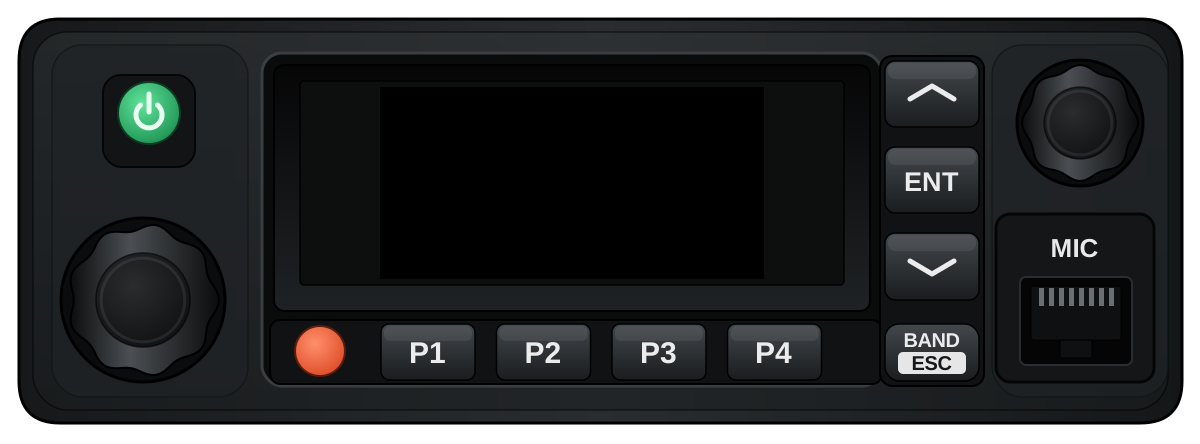
- Hold P1 and the orange (alarm) key while you connect the power again. The screen stays blank and the backlight blinks once a second.
- Release the keys.